Saturday, August 6, 2011

A less touristy park - Zhongshan Park

Beijing with its dry climate is not like London where I went recently. There, we can see green grass and trees, and beautiful parks and squares everywhere. However, Beijing's parks are far older and more colourful than London's oldest parks.

Beijing's finest parks were mostly built by the emperors for their own enjoyment, and one not so well-known one that I like is what was formerly called Central Park, now called Zhongshan Park (after Sun Yat-sen). Sun Yat-sen was one of the early political leaders at the turn of the 20th century who managed to bring down the Qing dynasty and to kick out the emperors from the Forbidden City for good.

Zhongshan Park was a former imperial garden, right next to the Forbidden City, and contains structures from the Ming dynasty over 600 years ago. It is a fine example of classical Chinese landscape gardening.
This is the Confucian Altar of Earth and Harvests, built in 1421, on a 3-storey platform made of white jade. The emperors would come twice a year and pray for good harvests (spring) and offer thanksgiving (autumn). Note the 5 different colours of earth representing all parts of the country ( north, south, east, west and central), as well as the Five Elements (Earth, Wood, Fire, Metal and Water).


Next to the altar is a new concert hall, so you can have a stroll in the park before or after a concert for free!

There are also old cypress trees from 1000 years ago.


There are many quiet spots in the park, with charming names such as Lotus Pool, Water-side Pavilion, Pavilion of Four Contentments, Kiosk for Meeting New Friends and the Pavilion to Welcome the Sunshine.


One part is not so quiet, here you can see an amateur Chinese music group practising on their instruments, including the two-stringed 'erhu'.


Long corridors provide shade and are brightly painted, as can be found in other parks and palaces.


This is another Chinese instrument, a set of bronze bells. You will also come across a museum, no prizes for spotting an Olympic stadium or two in the model of Beijing city below.


And do you recognise this young-looking figure?

Interesting example of Taihu stone, called 'A Slice of Clouds', and which used to be in the Old Summer Palace.

We all love to have our photo taken, complete with imperial headdress..........

............and not just for kids!

Maybe the most impressive part of thepark is the moat at the northern end, where the watchtowers and walls of the Forbidden City can be seen.


It's a favourite spot for young couples to spend a lazy afternoon.

but what's this photo of a young girl doing here?


and another......praying for the deceased?


......details of age, height, looks, job, salary, assets.......


No, this is something I'm sure you've never seen, it's the area of the park where anxious mothers and fathers of unmarried sons and daughters will come to 'advertise' the availability of their children, in the hope of finding them a suitable marriage partner. So it's a kind of open-air matchmaking market, open at weekends and public holidays. Chinese parents think this is their responsibility, and probably think they know better than their kids who would be a suitable spouse. Luckily, I don't have this problem! 


Perhaps this cartoon character, with the character 'fu' meaning happiness on his dress, is praying for good luck for the matchmaking! I also wish them goodluck, and if any of you need some help, I can take you to Zhongshan Park to browse around this special market.


Tuesday, July 26, 2011

Red Gate Gallery - 20 years in Beijing


One place I take art-loving clients to is the Red Gate Gallery ('Hong Men' in pinyin), which celebrates its 20th birthday this year. Not only can you see the best in contemporary Chinese art, but the gallery itself is located in an unique historical Ming Dynasty building.

Furthermore, you could not have a friendlier curator than the Australian Brian Wallace, alumnus of the Central Academy of Fine Arts. He is the gallery's founder and has been chosen in recent years by Time Out magazine as one of the top 40 heroes of Beijing.


The gallery is located in the Dongbianmen Watchtower, an impressive structure and one of the few remaining parts of the old 30m-high Ming dynasty city wall (park adjacent). It is at the south east corner of the second ring road, and is easily accessible by subway, in contrast to other sites such as 798 Art Zone (see blog of May 20th, 2011) and Caochangdi.


The Watchtower is a fine example of traditional Chinese architecture, and is almost 600 yrs old. It was started in 1436 and finished 4 yrs later. 

Apart from art exhibitions, two floors are devoted to some interesting artefacts, models and historic photos about the local district.


The current exhibition is called  '20 Years - Two Generations of Artists', and here are some pictures taken from the Red Gate gallery website http://www.redgategallery.com/

Zen Quote - Amitabha

No and Keng
Survivor
Food
Oil on Canvas
Watching the Battlescene
Not a Tree but Not Not a Tree

If you are a budding artist, you could also consider applying for the gallery's residency program which provides artists, curators, writers, and academics with the opportunity to live and create work in China.
The objective is to provide facilities for artists to easily start their projects and offer a community in which they can participate as much as they like. Red Gate assists all participants to connect with the art scene, meet local Chinese artists and to source art materials. They help get you settled, show you around, tell you where to buy the best Peking Duck, which part of the Great Wall not to go to (hey, they're beginning to sound like competitiors of ChinaMango!), and where and when the latest openings are.

Thankfully not all of you are artists and would be quite happy just to visit the 'must-see' sights of Beijing, as well as other places of interest that have been described in this blog over the past couple of years.  Do get in touch if you need any help.

Sunday, June 19, 2011

Capital location - Capital M restaurant

One of my favourite clients always takes me to dinner when in Beijing, he's so kind! If I were to choose, I would look for a small noisy dumpling or noodle place where the locals eat. However, this time it was his choice, and he chose Capital M which has been running successfully for sometime now.

As it says in their website, "Capital M offers diners an unforgettable combination of delicious, simply good food that is a collection of classics and nostalgic favourites; an iconic view of Beijing; a stunning ambience and warm service. Located on what has been Beijing's most celebrated shopping street for over 600 years - Qianmen Street -- Capital M is perfectly positioned for a breathtaking view of the city's heart. Whether from our terrace or our gorgeous interior, diners enjoy a view that unfolds from the Forbidden City to Qianmen Gate, including Tian'anmen Square."


            Just south of Tiananmen
Square, approaching
Qianmen St.

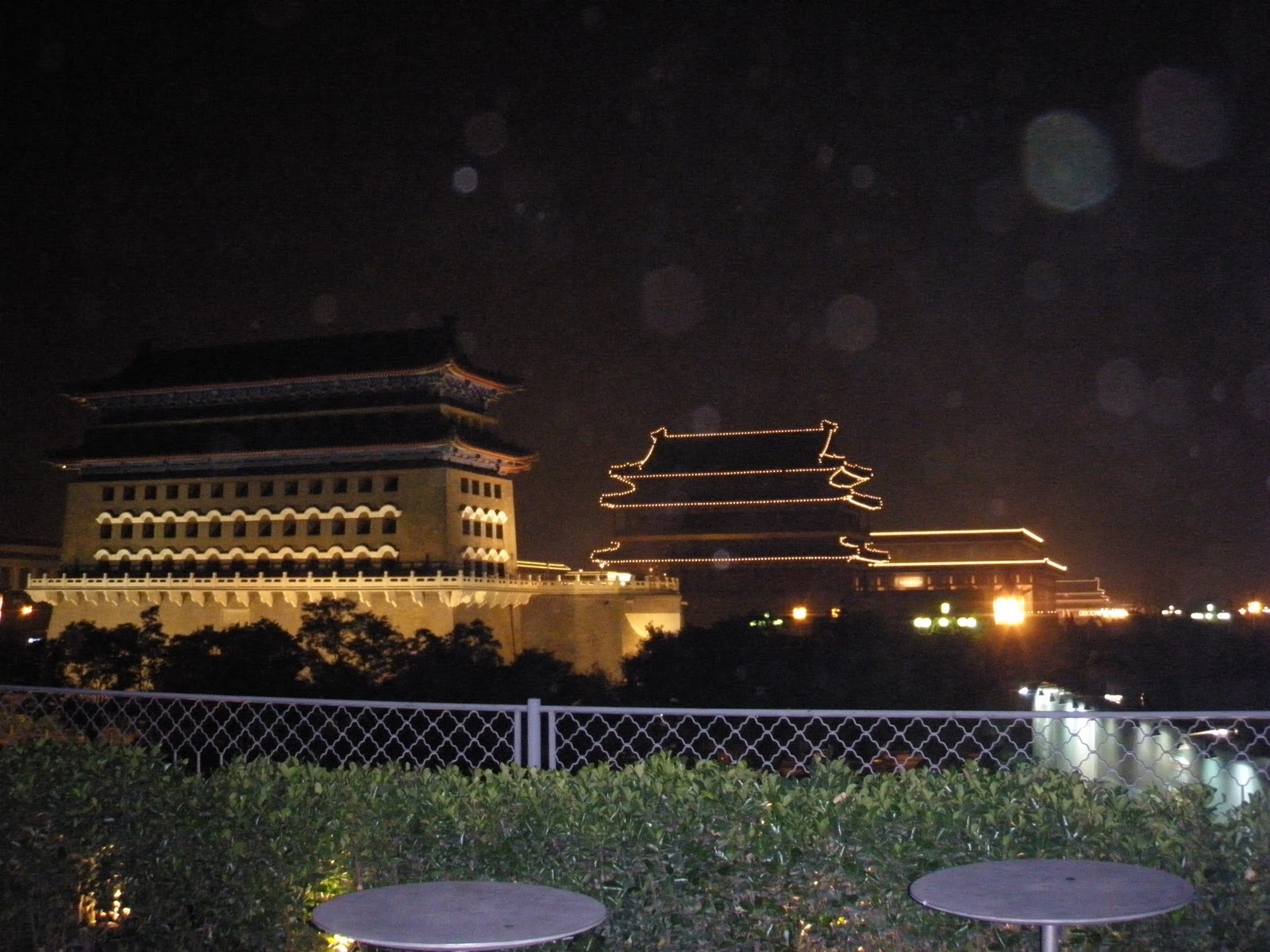
View towards Tiananmen Square, with old City Wall watchtowers and Mao mausoleum at the back
Once inside, it's a different world!


Here I am on the terrace enjoying the view.

The inside decor is definitely not Chinese!

Some idea of the food. Chinese is always my favourite but you may not agree.


Looking over the terrace onto QianMen St, you can see the original Quan Ju De Roast Beijing Duck shop, one of the time-honoured brands of China.
And another well-known brand....well not quite, only in China! 

So, I can take you to Capital M next time if you want some fine dining, a great Sunday brunch, a romantic drink at dusk, or take part in other social events such as Sunday afternoon teatime music recitals and literary festival.

I'm off to Europe for a month so please be a little patient before I write the next blog. Happy holidays to you all!