I have finally got some photos of my trip to Sri Lanka ready to show you. Most people have only heard of Ceylon (the country's old name before 1972) tea, but actually there is a lot to see and do there. It is a small island off the southern tip of India, and so holds a strategic position on trade routes between Europe and Asia. It was on the old maritime Silk Road, and had Chinese connections as early as the 5th century AD. The famous Chinese explorer Zheng He (also a eunuch in the Ming dynasty) visited Sri Lanka 6 times in the 1400s, well before Columbus got near America. Then followed the Portuguese in 1505, then Dutch and British traders.
The population is around 20 million, the same as Beijing or Shanghai roughly. Although a small island, it has a bit of everything...historical buildings, tropical flora and fauna, mountains, beaches, nature reserves, precious stones and lots of friendly smiling faces.

Our first stop was at Anuradhapura, an old capital from 2500 years ago. Numerous stupas and religious buildings remain.
Our first hotel was beautiful both indoors and outdoors.

We passed through several towns on the way to another World Heritage site, Sigiriya. Fortunately our minibus was more comfortable than this local taxi!

As expected there is lots of fruit around........

including red coloured bananas, a first for me!
The local people are very friendly, perhaps because of their buddhist teachings.

This town impressed me when I saw this sign.
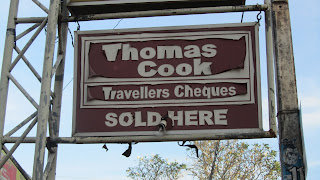
However I realised there must be something wrong when I saw the bank building itself.
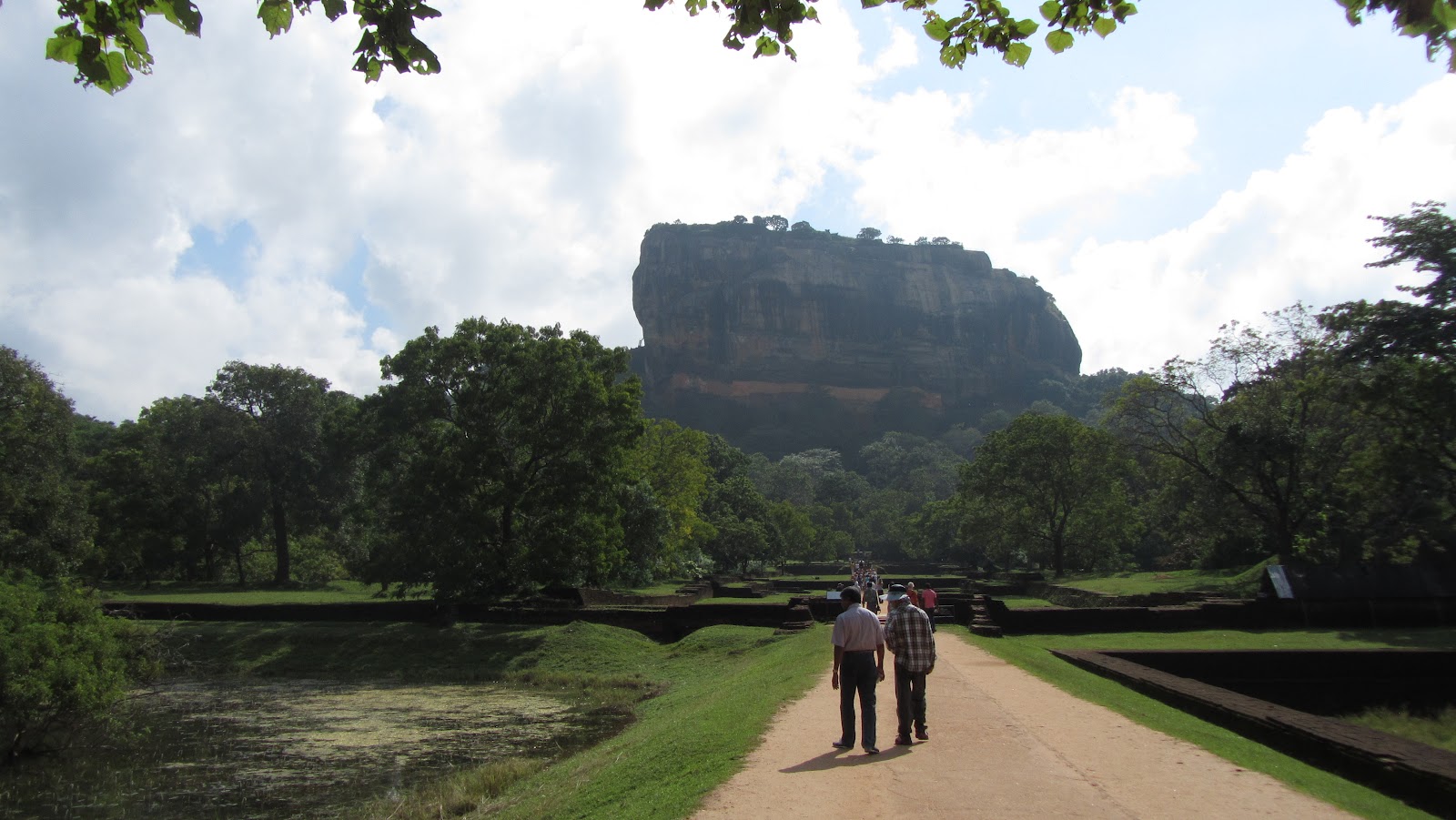
Sigiriya has a wonderful rock fortress built half way up this rock in the 4th century AD.

It is famous for its wall frescoes.

I got half way up, at the foot of the lions feet.

As expected there were many buddhist temples to be seen in Sri Lanka,

and lots of plants and flowers, and birds and animals.


We visited the famous Tooth Relic Temple at Kandy. It is said there is only one other such relic to be found, that is in Beijing (Badachu, see my blog of Aug 2009).

The tooth relic (of the Buddha) is contained in this golden case.


The Sri Lankan elephant is an important sub-species of the Asian elephant, but is in danger of extinction, with less than 6000 remaining on the island, and mostly kept in the nature reserves. It has been an important part of Sri Lanka's history and culture for over 2000 years.
This half elephant-half man is Ganesh, a god from the Hindu religion.


Hindu temple in Kandy, Sri Lanka's 2nd largest city.
 .
Arts and crafts based on local hardwood
Local batik based on local flora and fauna

Kandy was the capital of an old kingdom for over 200 yrs starting in the late 16th century, and was then subsequently taken over by the British. Nowadays, it has been taken over by Western food.......KFC on the high street of course....


We also managed to go to Adam's Peak, so called because a rock formation at the top is said by the Christians and Muslims to be the footprint of Adam, made when he was expelled from the Garden of Eden. The Buddhists claim it is the left footprint of Buddha, and not to be outdone, the Hindus say it is that of Shiva!

We got up at 1.30 am to climb the thousands of steps to the top with hundreds of others so as to see the sunrise at 5.30am
Coming down was much easier and not in the dark.
Signs of British colonialism at a roadstop at Ella.

Tea plantations at Nurawa-Eliya


Some of the tea ends up in souvenir shops, this one in the capital Colombo, in different blends from weak to strong to suit all tastes. It was certainly a very refreshing drink with milk added, but I think I still prefer Chinese tea!
One of many beautiful, uncrowded and uncommericalised beaches to be found all over the island.

It was strange seeing all these men sitting on poles, until we saw they were fishing. What a peaceful life!








 .


